
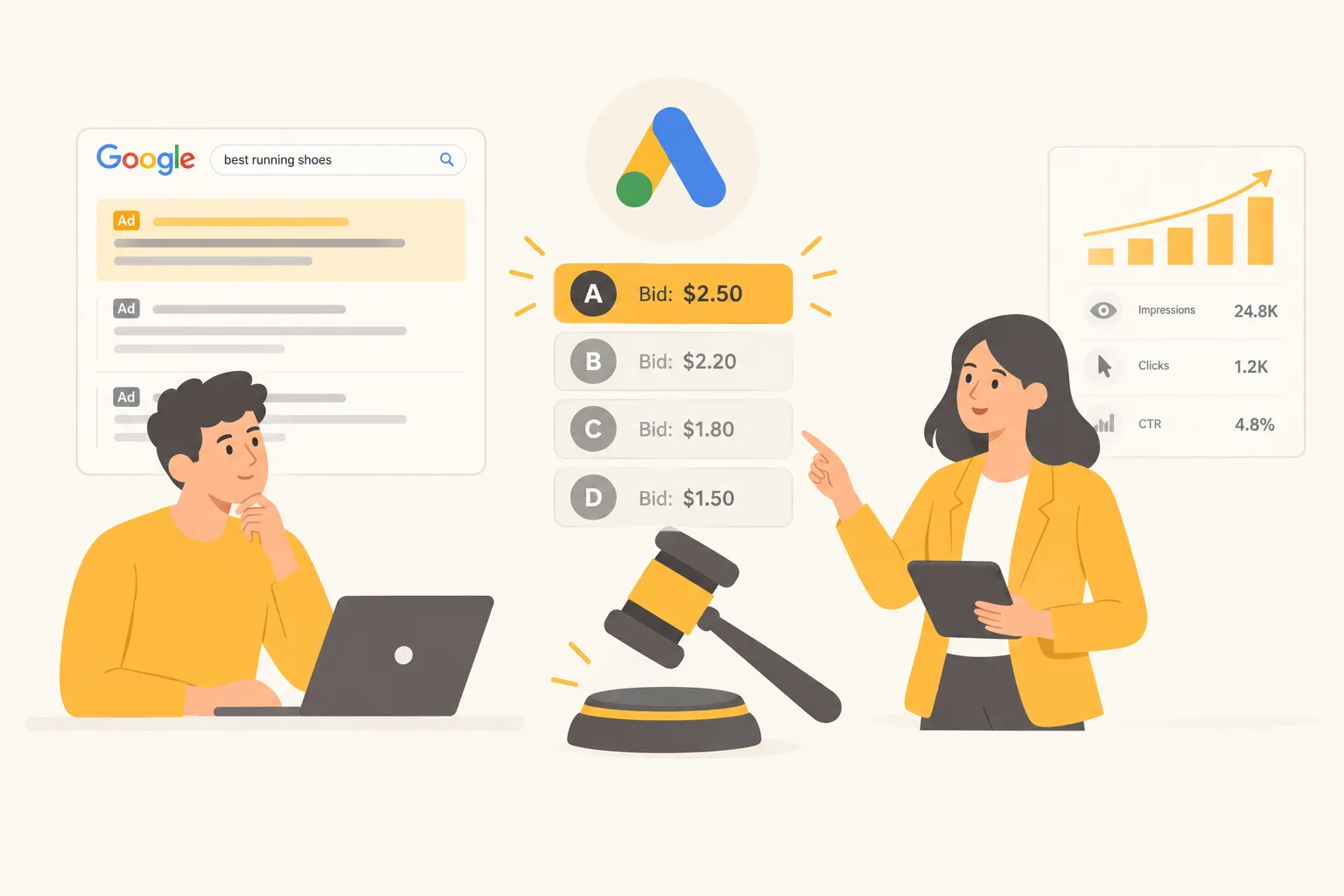
Most people know that Google Ads involves bidding. Fewer understand that the Google Ads auction is not a straightforward highest-bid-wins system. The way bids actually work – and how Google determines which ads appear, in what order, and what each advertiser pays – is more nuanced than it first appears. Understanding it gives you a genuine advantage over competitors who don’t.
How the Google Ads Auction Works: The Basics
Every time someone performs a search on Google, an auction runs in real time for that specific query. Advertisers who have keywords matching that query enter the auction, and Google determines which ads to show and in what order. An auction runs every time someone searches – meaning your ad’s position can vary from one search to the next even for the same keyword.
The key metric that determines your position in the auction is called Ad Rank. Google lists the factors behind every auction on its page How the Google Ads auction works.
What Is Ad Rank?
Ad Rank is a value Google calculates for each advertiser in each auction. It determines both whether your ad shows at all and where it appears.
Google does not publish a formula. Its help page lists six factors: your bid, the quality of your ads and landing page, the expected impact of assets and other ad formats, Ad Rank thresholds, the context of the search and the competitiveness of the auction.
So an advertiser with a lower bid but better quality can outrank a competitor with a higher bid. Spend matters, and so does the relevance of what you offer the searcher.
Ad Rank thresholds set a minimum bar. An ad must clear them to show at all, which keeps low-quality ads out even when the advertiser bids aggressively.
What You Actually Pay: The CPC Calculation
Your bid is the most you are willing to pay for a click. Google notes that what you actually pay is often less.
Google does not publish a cost formula either. It does say that in close auctions, ads that rank higher may pay more per click for a better chance of winning.
A Simple Hypothetical Example
Imagine two advertisers on the same keyword. One bids more but sends clicks to a slow, generic page. The other bids less but has a closely matched ad and a fast, relevant landing page. The second advertiser can win the higher position, because quality counts alongside the bid.
Related reading: How to Set Up a Google Ads Account the Right Way (From Scratch)
The Role of Ad Extensions in the Auction
One Ad Rank factor, the expected impact of assets (formerly called ad extensions), rewards advertisers who make full use of Google’s ad extensions (sitelinks, callouts, structured snippets, call extensions, lead form extensions). Google’s models estimate how much each extension will improve CTR, and higher estimated CTR means higher Ad Rank.
Practical implication: adding relevant ad extensions is one of the few ways to improve your Ad Rank without spending more on bids. It’s free to add extensions, and the Ad Rank benefit is real.
Real-Time Signals That Affect Each Auction
Ad Rank is not static – it’s recalculated for every auction using real-time contextual signals, including:
- Device: Whether the user is on mobile, desktop, or tablet
- Location: The user’s physical location and the location they’re searching about
- Time of day: Auctions at 9am and 11pm may produce different Ad Ranks for the same keyword
- Search query: Even within the same keyword, the exact phrase searched affects relevance signals
- Auction competitiveness: How many other advertisers are in this specific auction
This is why smart bidding strategies (Target CPA, Target ROAS) can outperform manual CPC at scale – they adjust bids for each of these signals in real time, something a human can’t do manually.
What This Means for Your Strategy
Understanding the Google Ads auction has direct implications for how you run your campaigns:
- Quality Score improvements have a multiplier effect: Better quality raises your Ad Rank without touching your bids – and lowers what you pay per click.
- You can outrank bigger spenders: A well-structured campaign with highly relevant ads and landing pages can outperform a competitor with a larger budget but poorly optimised account.
- Bid adjustments matter: Because the auction uses real-time signals, adjusting bids by device, location, time of day, or audience can meaningfully improve efficiency – you’re paying more only when the probability of conversion is higher.
- Extensions are non-optional: If you’re not using ad extensions, you’re giving up Ad Rank for free.
To see who you compete against in these auctions, read our guide to the Google Ads auction insights report.
Brand terms often behave differently in the auction, which our guide to branded vs non-branded search campaigns explains.
Frequently Asked Questions
Does the highest bid always win?
No. Position depends on Ad Rank, which combines your bid with ad and landing page quality, the expected impact of assets and the search context.
Do I pay my full bid?
No. Google notes that what you actually pay is often less than your maximum bid.
Final Thoughts
The Google Ads auction rewards quality as much as budget. An advertiser with a modest bid and a highly relevant, well-structured account can outperform competitors who spend more. Quality Score, landing page experience, and assets are your leverage points – the tools that let you compete on merit rather than pure spend.
If you find yourself constantly raising bids to maintain position, the underlying problem is almost always quality, not budget. Fix that first.
Marquee specialises in building high-Quality Score Google Ads accounts that compete efficiently – spending less to achieve more. Talk to us if your CPCs are climbing without a clear reason.
For e-commerce brands, how you structure your campaigns has a direct impact on how well the auction works in your favour. A well-segmented account gives the algorithm cleaner signals to bid on. See our guide to structuring Google Ads campaigns for e-commerce for a practical walkthrough.
Want expert help with your account? See our Google Ads management service.